
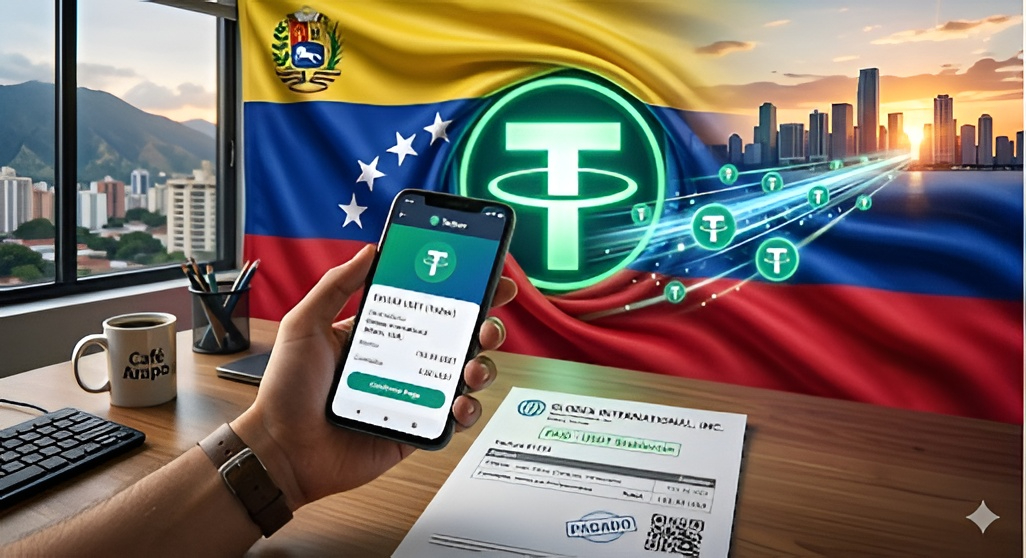
Paying invoices abroad from Venezuela through the traditional banking system can mean lengthy procedures, high fees, and long waits. Because of this, stablecoins have become very popular in the country, mainly due to their advantages, such as faster transactions and greater monetary stability. However, some myths about international USDT transactions still exist. Below, we address the main myths about paying international invoices from Venezuela.
Paying with stablecoins is illegal in Venezuela
Some business owners believe that using USDT or other stablecoins to pay suppliers abroad can run afoul of local authorities, but the reality is quite different. Although not legal tender, cryptocurrencies are regulated by the Constituent Decree on the Comprehensive System of Cryptoassets and by tax regulations, which require the declaration of income (ISLR) and the payment of taxes such as the IGTF (Tax on Financial Transactions). Therefore, the use of cryptocurrencies as a medium of exchange is not prohibited. What is illegal is tax evasion or using them for illicit activities.
Higher fees than bank transfers
Paying an international invoice via a traditional SWIFT transfer can cost hundreds of dollars in fees, plus the unfavorable exchange rate that some banks may apply. In contrast, using USDT on the Tron network (TRC-20), transaction fees are usually less than a few dollars, and confirmation time is just a few minutes.
Even on more expensive networks, the total cost remains competitive compared to traditional banking, especially when sending medium or large amounts. The key is to choose a platform that offers multiple networks and lets users select the most economical one.
Exclusive for Tech Experts
Much is said about cryptocurrency management and the need for advanced technical knowledge, including blockchain technology, manual private key management, understanding the structure of block explorers, decentralized finance, and more.
However, most Fintech companies offering USDT payment services have user-friendly, intuitive platforms, simplifying the process to the point where it’s as easy as using a modern banking application. To pay international suppliers in USDT, users only need to register on a trusted platform, verify their identity, load funds, and send USDT to the supplier’s address. The platform handles the rest automatically. Even people with no prior cryptocurrency experience can learn how to do this in under an hour with the help of tutorials or customer support.
International Suppliers Do Not Accept USDT
The adoption of USDT as a payment method has grown exponentially. Large e-commerce platforms, manufacturers, freelancers, technology service providers, and even logistics companies accept USDT directly or through payment processors (which automatically convert it to their local currency). As a result, transaction volume in stablecoins far surpasses that of Bitcoin for business payments, primarily because of their speed and stability.
Insecurity
Security is one of the biggest concerns for users, but myths often exaggerate the risk. While scams and user errors (such as sending funds to the wrong address) do exist, reputable platforms implement multiple security measures and layers of protection, such as two-factor authentication, address whitelisting, identity verification, cold storage for most funds, multi-asset custody, integrated security controls, data encryption, and more.
Therefore, losing money due to a massive hack is uncommon when using established and regulated services. Conversely, sending a traditional bank transfer also carries certain risks, such as errors in the recipient’s information, delays that result in fines, or the possibility of the bank freezing the funds due to regulatory or compliance checks.
It’s not recommended for paying high-value invoices
Some people think cryptocurrencies are only for small amounts, like streaming service payments or family remittances. However, stablecoins like USDT are designed precisely to efficiently transfer value, regardless of the amount. The only catch is that large amounts may require additional regulatory compliance checks (such as justifying the source of funds), something that also happens in traditional banking.
It’s better to wait for traditional banking to improve
Some entrepreneurs postpone adopting USDT, hoping that national banks or international transfers will become more agile, efficient, and economical. Despite this, the traditional banking system hasn’t improved significantly in recent years, especially in terms of speed or fees for cross-border payments. Meanwhile, the stablecoin ecosystem has continued to evolve, offering more and more options, greater liquidity, lower fees, and better integration with global commerce.
What are your thoughts on this? Do you know of any other myths about paying international invoices from Venezuela?
If you need to make international invoice payments from Venezuela, you can contact us by visiting the following link.