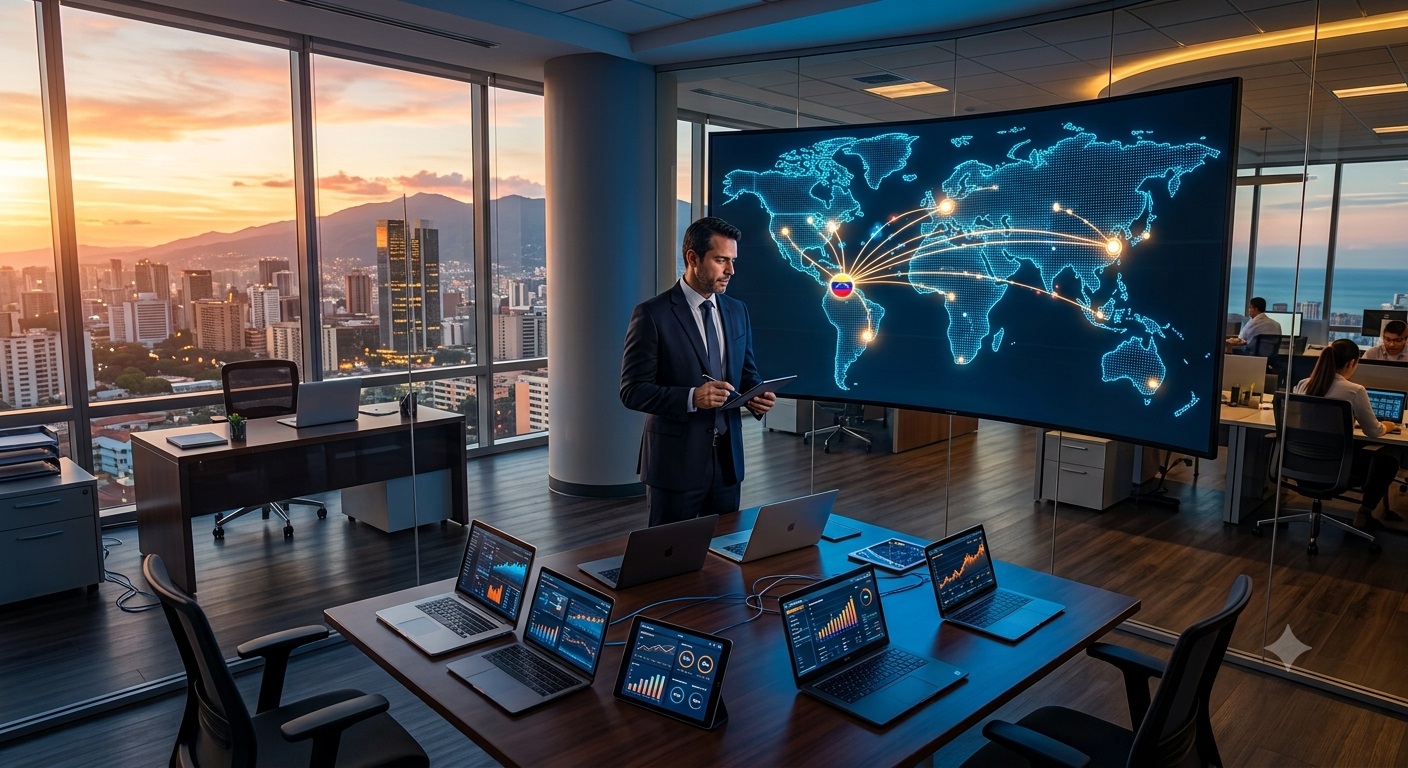
Expanding business operations beyond borders requires efficient, versatile payment channels that don’t become obstacles. For this reason, Venezuelan companies that trade with suppliers in different countries need to make payments quickly, but they also require a certain level of certainty about the final destination of each transfer and the ability to operate in multiple currencies without opening accounts in each country.
Given this need, payment platforms based on blockchain technology have begun offering solutions, providing an infrastructure that operates 24/7 and is not dependent on the schedules or policies of traditional banks. However, the market offers a wide range of options, and not all alternatives are prepared for the pace of international trade and global B2B payments. Therefore, below we share some tips for choosing a global B2B payment platform from Venezuela.
Broad Coverage and Supported Currencies
A platform that only allows sending funds to a limited number of countries or that works exclusively with a single stablecoin can be a limiting tool, especially when a company wants to expand its business operations or diversify its markets. B2B transactions often involve suppliers in Asia, Europe, and the Americas, and each region has particular preferences regarding the digital currency it uses or the blockchain network it considers most efficient.
Choosing a service that offers broad coverage and supports multiple stablecoins protects the company against changes in its business relationships. If a new provider emerges (in a region where another cryptocurrency or a different network predominates), the company won’t need to look for a new payment provider and can continue operating on the same platform it already uses.
Liquidity to Support Transactions
If a platform performs fast currency conversions but lacks sufficient liquidity to handle a high-volume payment (or cannot process the transaction without affecting the exchange rate), it will be ineffective at the enterprise level. The supplier’s liquidity (the ability to process large transactions without adverse price changes) is an indicator of stability and reliability, which should always be verified when evaluating a supplier.
Working with a supplier with a robust liquidity network provides companies that handle large payments with a degree of security. This characteristic is highly relevant in the Venezuelan context, where the popularity of USDT has driven the emergence of numerous services, but not all have the financial backing to guarantee large-scale operations without limitations or problems.
Flexibility to adapt to different business models
Not all companies or B2B payments operate in the same way. For example, some companies need to pay a stable group of suppliers every month, while others work with a rotating network of contractors (whose payment information changes frequently). As we can see, a platform that only works well for the first case may be rigid and inefficient for the second. Choosing a service that supports multiple payment methods aligns with the evolving reality of Venezuelan businesses. The ability to switch between different formats without migrating to another platform reduces operational friction and allows the organization’s finance team to focus on higher-value tasks.
Platform Resilience and Service Continuity
In international trade, a payment service interruption of even a few hours can lead to breaches of contract, penalties, and, above all, damage relationships with suppliers. Therefore, it is advisable to evaluate the platform’s operational availability history and the contingency mechanisms it has in place for high-demand scenarios or technical failures.
Having a provider that has demonstrated operational stability over time guarantees that payments will be made even during critical moments, especially when traditional banks often impose additional restrictions. It is important to highlight that some organizations that have already overcome the main myths about international payments with cryptocurrencies particularly value this aspect, as they have experienced (firsthand) the difference between an efficient and versatile service and one that freezes at the first sign of trouble.
Integration with the local financial ecosystem
Even though payments are made in stablecoins, the company is still based in Venezuela and needs to demonstrate the origin and final destination of funds within the local financial system. A platform familiar with the Venezuelan market can guide its users on available funding methods, processing times for each transaction, and the documentation typically required by banking institutions.
Choosing a provider with up-to-date knowledge of the local environment is a competitive advantage that helps avoid surprises and streamline the organization’s administrative processes. It’s important to note that this integration with the Venezuelan reality extends beyond technical aspects to include language, time zones, and an understanding of the limitations faced by Venezuelan companies. This translates into a more efficient and less cumbersome business payment service.
Transparency in execution
Each international payment must be documented to support it before internal control bodies and, if necessary, before tax authorities. Platforms that offer downloadable reports detailing each transaction (including amounts, dates, networks used, blockchain hashes, and beneficiary information) facilitate reconciliation and reduce the accounting department’s administrative burden.
Therefore, working with a service that prioritizes document transparency is a best practice that strengthens corporate governance. For example, many Venezuelan companies that use USDT for international payments have discovered that the quality of receipts issued by the platform can make a significant difference during an audit, as clear, verifiable records streamline procedures and convey professionalism to auditors.
What are your thoughts on this? What other advice do you have when choosing a B2B global payments platform from Venezuela?
If you would like to learn more about our B2B global payments services from Venezuela, you can contact us by visiting the following link.